Lab architecture
Technical design of the FCEFyN HIL testbed: per-lab labgrid-coordinator (loopback) + SSH gateway VM shared with the openwrt-tests ecosystem, DUTs available for both openwrt-tests and libremesh-tests, and dynamic VLAN as a per-test attribute.
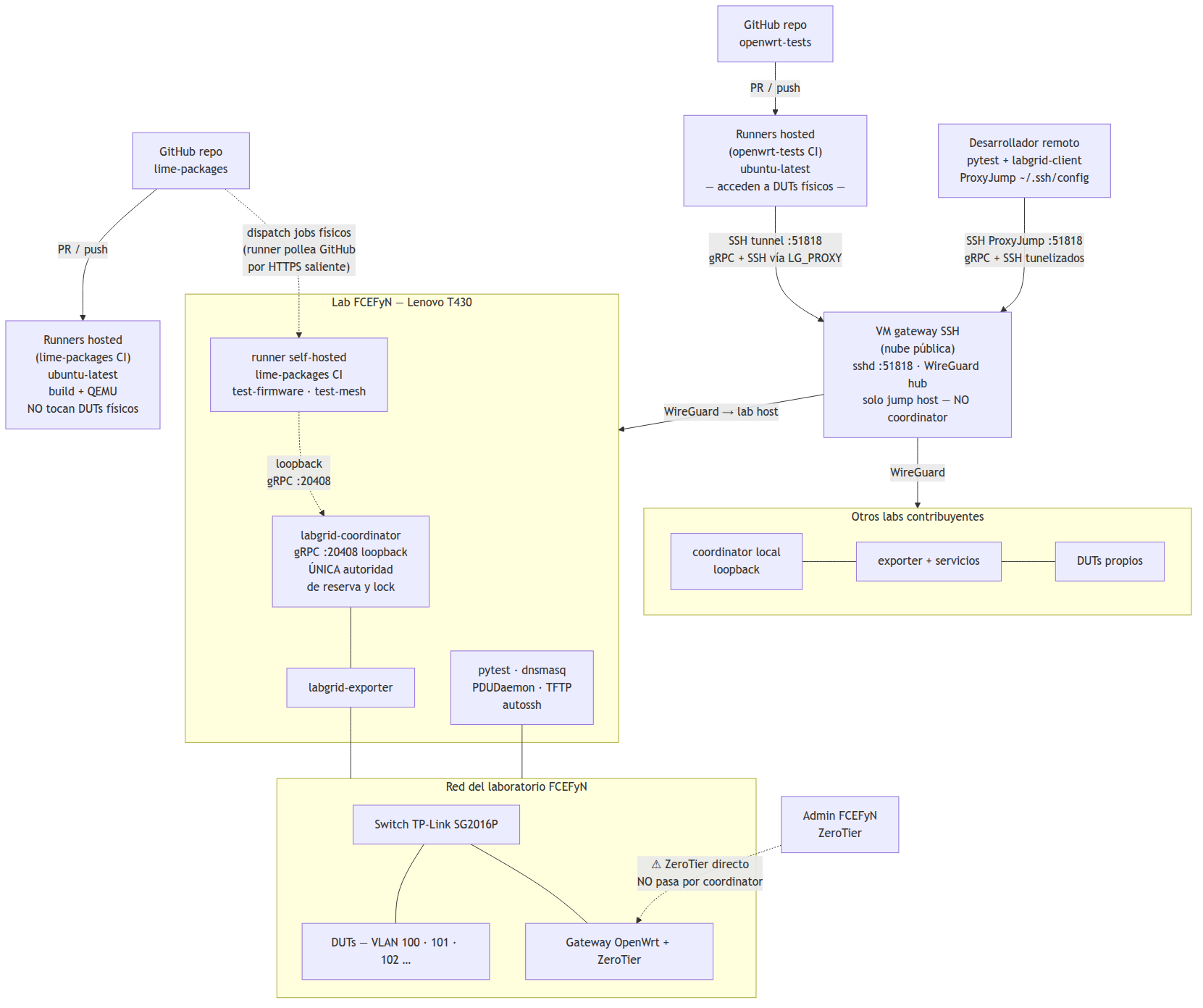
1. Overall design
The diagram above shows the complete system. Key elements:
| Element | Description |
|---|---|
| Paul's VM (public cloud) | Datacenter VM acting as SSH gateway (global-coordinator hostname). Does not run labgrid-coordinator. GitHub-hosted runners (ubuntu-latest) reach labs through it via WireGuard. |
| FCEFyN Testbed (on-prem) | Orchestration host running labgrid-coordinator (loopback :20408), labgrid-exporter, pdudaemon, dnsmasq/TFTP, and the libremesh-tests self-hosted runner. DUTs connect via managed switch. |
| Remote Labs | Other contributors' labs. Each runs its own local labgrid-coordinator + labgrid-exporter. A lab may serve openwrt-tests, libremesh-tests, or both. |
| GitHub Actions | Push/PR events trigger CI workflows. openwrt-tests jobs run on GitHub-hosted runners (tunneled via gateway VM); libremesh-tests jobs run on the FCEFyN self-hosted runner. |
Per-lab coordinator, two test suites
Each lab runs its own labgrid-coordinator locally (loopback :20408). Both openwrt-tests runners (GitHub-hosted, tunneling via the SSH gateway VM) and the libremesh-tests runner (self-hosted on the FCEFyN host) connect to the same local coordinator on the lab host. Labgrid locks serialize device access - only one runner holds a device at a time, regardless of which project triggered the job.
For the full connection topology (WireGuard, LG_PROXY) see Integration overview.
2. Per-project device opt-in
Each lab's coordinator sees only the devices registered by its local exporter. It does not distinguish between projects. The filtering of which labs participate happens at the CI configuration level:
| Project | Device registry | Who decides which labs participate |
|---|---|---|
| openwrt-tests | labnet.yaml in the openwrt-tests repo |
Lab maintainer submits a PR adding their lab to labnet.yaml |
| libremesh-tests | Own configuration (env vars, device list) | Lab maintainer adds their lab to the libremesh-tests config |
This means a lab can contribute devices to one project, the other, or both:
- A lab listed only in openwrt-tests'
labnet.yamlwill never receive libremesh-tests jobs. - A lab listed only in the libremesh-tests config will never receive openwrt-tests jobs.
- The FCEFyN lab appears in both, so its DUTs serve both projects (serialized by the lab's local coordinator locks).
Each lab coordinator is "project-agnostic" - it only manages locks and resource registration. The decision of which devices to test on which project belongs to each repository's CI configuration.
3. VLAN architecture
3.1 Design principle
The VLAN on a DUT port follows the test run that holds the Labgrid lock: the test applies the VLAN it needs at start and restores the port on teardown. Labgrid locking serializes access so two jobs do not reconfigure the same port at once.
3.2 Components
| Component | Role |
|---|---|
| Coordinator | Local per lab (loopback :20408) |
| Exporter | One labgrid-exporter process for all DUTs |
| DUT inventory | dut-config.yaml (hardware database for Labgrid and switch port mapping) |
| VLAN scheduling | Per-test VLAN where needed; Labgrid lock serializes access |
flowchart LR
    subgraph lab ["FCEFyN lab host"]
        COORD["labgrid-coordinator\n(loopback :20408)"]
        EXP["labgrid-exporter"]
        SW["Switch TP-Link\n(VLANs 100-108, 200)"]
        DUTs["DUTs"]
    end

    EXP -->|"gRPC loopback\n(register resources)"| COORD
SW -->|"access port\n(isolated or VLAN 200)"| DUTs3.3 Default state: isolated (fail-safe)
All switch ports start on their isolated VLAN (100-108):
- openwrt-tests needs no VLAN changes
- If a test fails or the runner crashes, the DUT stays isolated (no cross-talk)
3.4 Exporter SSH model (single config, two access modes)
The exporter declares NetworkService.address: "192.168.1.1%vlanXXX" - the default OpenWrt br-lan IP reachable via socat + SO_BINDTODEVICE. This is the only exporter config; it does not change between projects.
| Project | SSH access | VLAN state |
|---|---|---|
| openwrt-tests | Labgrid SSHDriver -> 192.168.1.1%vlanXXX |
Isolated (default) |
| libremesh-tests (single-node) | Same as openwrt-tests | Isolated (default) |
| libremesh-tests (mesh) | Serial for setup, then direct SSH to per-DUT mesh SSH/control IPs (10.13.200.x) on vlan200 |
Shared (fixture switches VLAN) |
Mesh tests bypass SSHDriver after the VLAN switch because isolated-mode 192.168.1.1%vlanXXX is no longer unique once multiple DUTs share VLAN 200. The host connects to each node through its per-DUT mesh SSH/control IP in 10.13.200.x, while the actual LibreMesh assertions use the node's real 10.13.x.x address on br-lan. The mesh_vlan fixture (section 4) handles the switch and restore.
3.5 Dynamic VLAN: the test that needs it changes it
Multi-node tests (libremesh-tests mesh, openwrt-tests multi-node) switch DUTs to a shared VLAN. Flow:
sequenceDiagram
    participant CI as libremesh runner
    participant COORD as Lab Coordinator (loopback)
    participant SW as Switch
    participant DUT as DUT port

    CI->>COORD: reserve device=belkin_rt3200
    COORD-->>CI: place allocated
    CI->>COORD: lock place
    CI->>SW: set_port_vlan port 12 vlan 200
    SW->>DUT: Port moves to VLAN 200
    Note over CI,DUT: Test runs - serial flash SSH
    CI->>SW: set_port_vlan port 12 vlan 101
    SW->>DUT: Port restored to isolated VLAN
CI->>COORD: unlock placeSwitching overhead: 2-5 s (SSH to switch + CLI). Negligible vs flash + boot (minutes).
3.6 Static infrastructure (all VLANs always on)
Configured once and left alone:
| Component | Permanent configuration |
|---|---|
| Switch uplinks (ports 9, 10) | Trunk of ALL VLANs (100-108 + 200) |
| Host netplan | vlan100-108 AND vlan200 up |
| dnsmasq | Instances for all VLANs (DHCP + TFTP) |
| Gateway | Interfaces for all VLANs |
4. switch-vlan CLI (labgrid-switch-abstraction)
Implementation lives in labgrid-switch-abstraction: a SwitchClient + per-vendor driver, exposed as the switch-vlan CLI (with a set_port_vlan(dut_name, vlan_id) Python entry point underneath). DUT-to-port resolution comes from dut-config.yaml on the lab host.
switch-vlan belkin_rt3200_1 200       # move to mesh
switch-vlan belkin_rt3200_1 --restore  # restore isolated
switch-vlan --restore-all              # restore all DUTs
The primitive already exists on the driver interface (assign_port_vlan_commands(port, vlan_id, mode, remove_vlans)); the CLI adds DUT-name resolution and an flock to serialize concurrent runs (/tmp/switch.lock). Host lock file, permissions, and metrics-tunnel timeout: Switch SSH lock.
Pytest fixture (libremesh-tests)
tests/conftest_vlan.py shells out to switch-vlan (not the Python API directly): when LG_PROXY is set, the command runs on the lab host via SSH, so a remote developer never needs the switch driver or credentials locally. The fixture switches each DUT to VLAN 200 at setup and always restores the isolated VLAN at teardown.
For state-machine level detail of UBootTFTPStrategy, mesh subprocess boot (mesh_boot_node.py), and pytest fixture order (mesh_vlan_multi, mesh_nodes), see Labgrid mesh strategy and orchestration.
5. Repository split
| Repo | Responsibility |
|---|---|
| openwrt-tests (upstream) | Vanilla OpenWrt tests, single and multi-node |
| libremesh-tests | LibreMesh-specific tests, mesh multi-node |
| fcefyn_testbed_utils | Lab infrastructure, Ansible, scripts |
| labgrid-switch-abstraction | Vendor-agnostic switch management (VLAN, PoE) |
6. Layers and upstream contribution
flowchart TB
    subgraph layer1 [Layer 1 - Switch Abstraction - contributable]
        DRV[switch_drivers/\ntplink_jetstream openwrt_ubus]
        SC[SwitchClient\nNetmiko]
        VM["switch-vlan CLI\n(set_port_vlan)"]
        DRV --> SC
        SC --> VM
    end

    subgraph layer2 [Layer 2 - Topology Fixture - contributable]
        TF["topology_fixture\ngeneric pytest\nVLAN per test restore teardown"]
    end

    subgraph layer3a [Layer 3a - libremesh-tests]
        MF["conftest_mesh.py\nVLAN 200 N devices"]
    end

    subgraph layer3b [Layer 3b - openwrt-tests future]
        WF["multi-device fixture\nWiFi speed test"]
    end

    VM --> TF
    TF --> MF
TF --> WFLayer 1 supports an abstract layer for switches or network topologies.
Layer 2 enables multi-device tests for openwrt-tests (WiFi speed, golden-device pattern).
7. Switch Topology Daemon (future)
The library inside labgrid-switch-abstraction is the base for a daemon. If an HTTP API is needed (like PDUDaemon), add an HTTP server on top of set_port_vlan(). Internal logic stays the same.
8. Trade-offs
| Aspect | Value | Mitigation |
|---|---|---|
| WireGuard dependency | All testing depends on the tunnel | Stable WireGuard with keepalive; temporary local coordinator fallback |
| Coordinator API latency | Lock/unlock via WireGuard | Light messages; SSH to DUTs is local |
| dnsmasq complexity | 9+ VLANs at once | One-time config; independent instances |
| VLAN switching overhead | 2-5 s per multi-node test | Negligible vs flash + boot (minutes) |